

🎧
Listen to this article
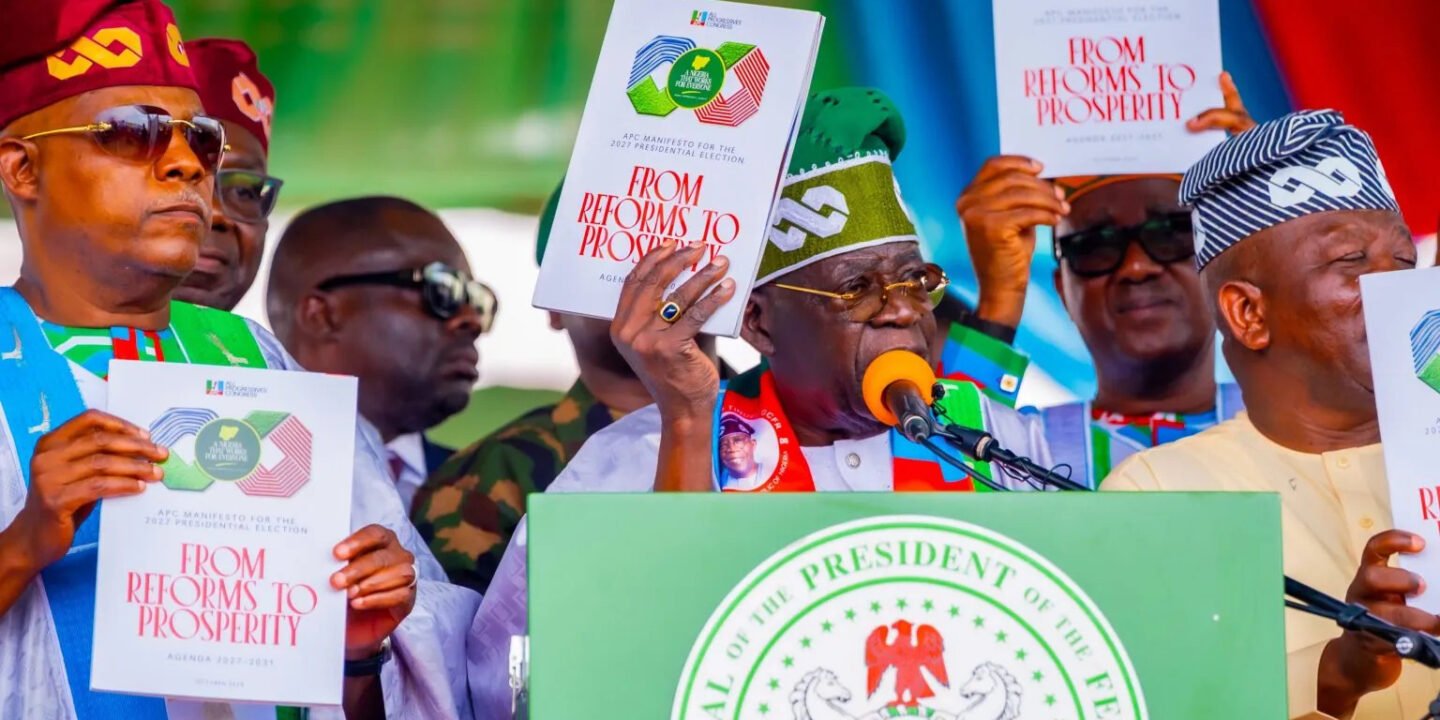
President Bola Tinubu’s campaign manifesto for the 2027 general elections has reintroduced several major policy commitments originally presented by the All Progressives Congress (APC) ahead of the 2023 polls, updating several key proposals with fresh timelines and numerical targets.
Titled Renewed Hope Agenda 2.0, the document outlines the ruling party’s blueprint for a potential second term spanning 2027 to 2031.
The manifesto structures its commitments across four core pillars: Secure and Resilient Nation; Better Quality and More Affordable Life for Every Nigerian; Energy, Infrastructure and Economic Growth; and Effective and Accountable Governance.



A comparative analysis of both manifestos shows strong continuities across primary governance sectors including national security, housing, agriculture, electricity, healthcare, transportation, youth employment, judicial reform, and women’s empowerment.
Sectoral Breakdown: 2023 vs 2027 Commitments
While the broad policy objectives remain aligned with the 2023 promises, the 2027 framework attaches revised performance metrics to key sectors:
- Housing: The 2023 manifesto pledged structural legal reforms and mortgage market expansion. The 2027 document introduces concrete delivery targets, promising 200 homes across each of the 774 local government areas (154,800 units total), targeting 200,000 homes overall, and capitalizing the Mortgage Refinance and Investment Fund (MREIF) toward N1 trillion.
- Healthcare: The target to extend mandatory national health insurance coverage to 40 per cent of the population—originally slated for achievement within two years in the 2023 manifesto—has been pushed forward to a 2031 deadline in the new document. It also sets a goal of raising functional primary health centres from 53 per cent to 90 per cent by 2031.
- National Security: The 2027 manifesto expands on previous security recruitment drives by detailing specific quotas: 28,000 additional military personnel, 50,000 police officers, and 30,150 Civil Defence personnel, alongside legal frameworks for state and community policing.
- Youth Employment & Skills: Building on the earlier Digital MSME Academy proposal, the 2027 plan pledges to halve youth unemployment by 2031, target 30 million Nigerians for digital literacy training, and launch a dedicated Youth Bank.
- Agriculture & Infrastructure: The new manifesto retains price stabilization initiatives like the Guaranteed Minimum Price scheme while proposing a monthly food-price tracker, cold-chain storage facilities, and dedicated intermodal transport corridors connecting agricultural and manufacturing hubs.
- Gender Inclusion: Both manifestos maintain a formal target of securing at least 35 per cent representation for women in cabinet positions and public appointments.
Overall, the Renewed Hope Agenda 2.0 indicates that the administration is maintaining its foundational 2023 policy direction while establishing adjusted implementation schedules and specific delivery metrics ahead of the 2027 elections.








No Comments