

🎧
Listen to this article
The Nigeria Labour Congress (NLC) and the Trade Union Congress of Nigeria (TUC) have officially resolved their recent public dispute triggered by the ₦70,000 six-month transport allowance approved by President Bola Tinubu for Nigerian workers.
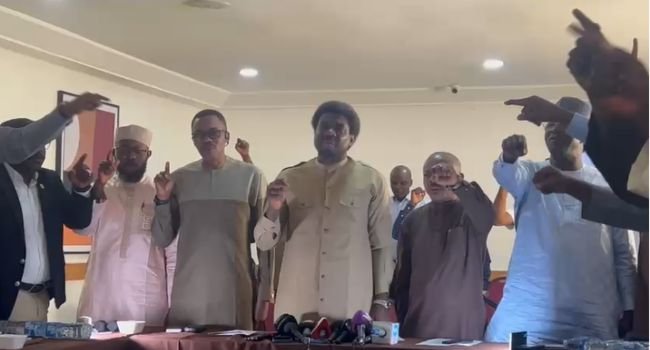
Both labour centres announced the truce on Wednesday during a joint press briefing in Abuja. In a communique jointly signed by NLC President, Joe Ajaero, and TUC President-General, Festus Osifo, the unions admitted that their differences had spilled into the public space, but maintained that their collective duty to Nigerian workers overrides institutional or leadership friction.
Reiterating their dedication to a united labour front and the joint protection of workers’ interests, the two leaders characterized the rift as an internal family misunderstanding that was amicably settled following the mediation of past leaders of both congresses.


The public exchange began after the Federal Government approved a ₦70,000 monthly transport intervention for workers across all cadres for six months—a deal negotiated solely by the NLC.
Appearing on Channels Television’s The Morning Brief, Ajaero contended that the NLC possesses the mandate to negotiate independently on labour issues under International Labour Organization (ILO) guidelines regarding most representative workers’ organizations.
“TUC can negotiate along with NLC, but NLC can negotiate alone based on the principle of most workers representatives of the ILO,” the NLC President stated, adding that the TUC does not submit proposals to his congress and claiming that labour authorities engage the NLC directly on welfare matters.
However, in a separate appearance on the same programme, Osifo dismissed the ₦70,000 agreement as an aberration, protesting that the TUC was sidelined during the talks. He challenged Ajaero to present any ILO statute authorizing one labour centre to negotiate on behalf of another without consultation.
“He should show me in the ILO Regulations where it says one party is going to negotiate without the other one being there or consulted. He should show me! He should show Nigerians!” Osifo demanded.
Questioning Ajaero’s stance, the TUC leader remarked: “As I listened to Ajaero today, I was wondering if it is the same NLC that produced the likes of Adams Oshiomole, Hassan Sumonu, Ayuba Wabba and so on. There is nowhere in ILO regulations that says a trade centre cannot negotiate for its members. It is not there! It is just that if you are going to the ILO, it is tripartite- the labour, government and the employers.”
Responding to Osifo’s assertion that the TUC commands over 300,000 members in the federal civil service, Ajaero cited Section 40 of the 1999 Constitution and the 2005 Trade Union Amendment Act, noting that union membership is strictly voluntary.
“The 2005 Trade Union Amendment Act made membership of trade unions voluntary. It is the worker that determines the union he belongs to. Section 40 of the Nigerian 1999 Constitution as amended was clear that every Nigerian worker has the right to belong to any trade union, political or religious institution of his choice, which gives every worker the latitude to belong to any union of their choice,” Ajaero explained, arguing that seven of the eight unions in the Joint National Public Service Negotiating Council (JNC) belong to the NLC.
Osifo countered that while the NLC holds roughly 60 affiliates compared to the TUC’s 40, neither body can unilaterally negotiate for workers represented under a separate umbrella, insisting that the meeting which produced the ₦70,000 deal lacked a valid JNC quorum.
“But that meeting that took place was not the Council meeting. The Minister is not a member of the Council. Ajaero is not a member of the Council. The Council even has a quorum and the number of persons that must be seated to form a quorum. But at the end of the day, that meeting was not a JNC meeting. The members of JNC were not there!” Osifo stressed, adding that consequential adjustments should properly be handled by the JNC.
Defending the intervention, Ajaero maintained that the ₦70,000 allowance emerged after the NLC issued a strike ultimatum and engaged the government, noting that formal minimum wage negotiations require a duly constituted tripartite committee.
Meanwhile, the Federal Government on Tuesday approved the establishment of a High-Powered Committee to review demands submitted by the TUC concerning a new national minimum wage and broader economic challenges.
According to a statement issued on Tuesday by TUC Secretary-General, Comrade General N.A. Toro, the resolution followed a meeting chaired by the Secretary to the Government of the Federation (SGF), Senator George Akume, in response to the union’s letter dated October 8, 2026, titled “Request for an Urgent Meeting to Address Critical National Economic, Security and Labour Challenges.”
During the talks, the TUC reiterated its rejection of the temporary six-month ₦70,000 transport package, advocating instead for a permanent salary increment ahead of formal minimum wage negotiations.
“In the course of the deliberations, the TUC made its position unequivocally clear on the proposed ₦70,000 transport intervention for a period of six months, which it rejected, preferring instead a salary increase pending the commencement and conclusion of discussions on a new National Minimum Wage,” the TUC statement read.
“This position, alongside the other demands and concerns raised by Congress, will form part of the issues to be thoroughly interrogated by the High-Powered Committee,” it added.
The newly constituted committee—comprising three TUC representatives led by the Secretary-General alongside officials from the OSGF, the Office of the Head of the Civil Service of the Federation, the National Salaries, Incomes and Wages Commission, and the Federal Ministry of Labour and Employment—has been mandated to commence sitting immediately and submit its recommendations to the SGF within two weeks.








No Comments