

🎧
Listen to this article
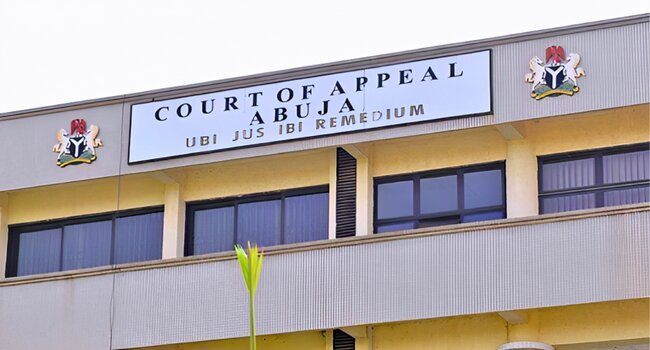
The Court of Appeal in Abuja has overturned a previous Federal High Court judgment that nullified the election timelines issued by the Independent National Electoral Commission (INEC) for the 2027 general elections.
In a unanimous decision delivered on Thursday, a three-member appellate court panel upheld the appeal filed by the electoral umpire, declaring it meritorious.
The appeal challenged the lower court’s ruling which was delivered on May 20.
According to the Appeal Court, the trial judge failed to adhere to binding legal precedents. The panel clarified that INEC’s Revised Timetable for the general elections operates as a subsidiary legislation to the 2026 Electoral Act.
Therefore, it carries the same legal weight as the Act itself, meaning INEC acted entirely within its statutory powers.
The appellate court affirmed that all the deadlines outlined in the 2027 Revised Timetable are well within the boundaries of the Electoral Act.
In its notice of appeal filed on May 25, INEC had raised nine grounds, urging the appellate court to review and set aside the high court’s ruling.
Aside from arguing that the trial court failed to address a critical jurisdictional issue, INEC asserted that the lawsuit initiated by the Youth Party (YP) was merely academic and hypothetical. The commission stated that the trial court’s failure to rule on these core issues denied them a fair hearing.
Furthermore, INEC argued that the high court made a legal error when it ruled that:“It is clear from the wordings of Sections 29(1), 82 and 84 of the Electoral Act, 2026, the following can be understood. Section 29(1) of the Electoral Act, 2026 mandates Political Parties to submit the names of candidates in prescribed forms of the candidates who emerged from their valid primaries which such a political party intends to sponsor at the elections, not later than 120 days before the date of the General Election.
“What is required of Political Parties to do under the Electoral Act, 2026 is to notify the Independent National Electoral Commission (INEC) 21 days before the holding of its primaries, congresses or conventions, days before the holding of its primaries, congresses or conventions, or any conference or meeting convened for the election of its executive committees, other governing bodies for nominating candidates.
“The Defendant is not mandated to impose a timeframe for political parties to conduct their primaries provided that it will be done and submitted not later than the 120 days provided by the Electoral Act, 2026. See Section 82(1) of the Electoral Act, 2026.”
INEC maintained that the lower court’s verdict contradicted the weight of evidence presented by the parties involved.
Consequently, it requested the appellate court to grant the appeal, nullify the previous judgment, and strike out the YP’s case for lacking the legal right (locus standi) to file the suit.
Previously, Justice Mohammed Umar of the Federal High Court had invalidated INEC’s specified timelines for conducting primaries and nominating candidates.
The judge also canceled INEC’s May 10 deadline for political parties to submit their membership registers as a prerequisite for participating in the elections.
The trial court had concluded that the timeframe imposed by the Commission for parties to hold primaries and manage the submission, withdrawal, or replacement of their candidates “is inconsistent with the provisions of the Electoral Act, 2026.”
This initial ruling stemmed from a lawsuit (marked FHC/ABJ/CS/517/2016) filed by the YP, which sought to force INEC to strictly follow the 120-day pre-election deadline outlined in the Electoral Act.
The party argued that INEC’s power to receive notices and monitor primaries did not give it the authority to dictate the exact timetable for political parties to nominate candidates for 2027.
Siding with the Youth Party at the time, Justice Umar declared that based on Section 29(1) of the Electoral Act, 2026, which mandates candidate submission no later than 120 days before an election:
“INEC cannot lawfully abridge or limit that statutory period by prescribing a shorter timeframe in its 2027 election timetable.”
Additionally, the trial court had ruled that under Section 31 (allowing candidate substitution up to 90 days before an election) and Section 32 (regarding the publication of final candidate lists), INEC lacked the statutory power to shorten these periods by setting earlier deadlines in its 2027 election schedule.










No Comments