

🎧
Listen to this article
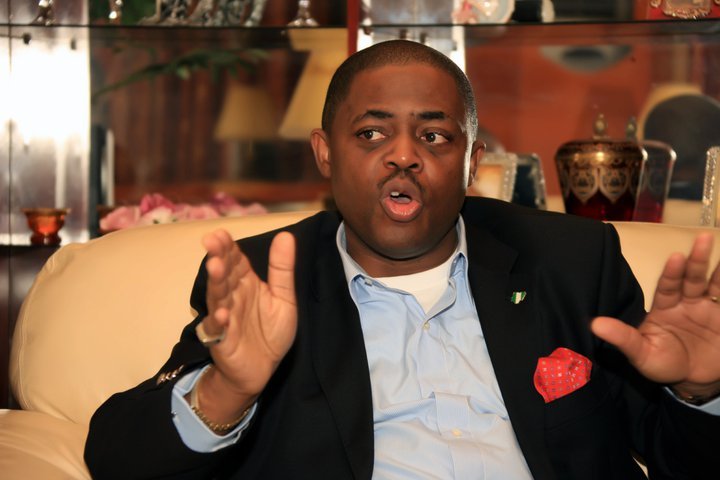
Nigerian High Commissioner to South Africa, Chief Femi Fani-Kayode, has recounted how he confronted former Vice President Atiku Abubakar during full Federal Executive Council sessions, demanding his removal from cabinet meetings on two separate occasions.
Writing in an article titled, “The Seventh Bid of Waziri,” Fani-Kayode detailed the political friction that transpired within former President Olusegun Obasanjo’s administration while he served as Minister of Aviation.
Fani-Kayode explained that Atiku’s actions against Obasanjo reached a point where he felt compelled to take an unprecedented step during cabinet deliberations.
“Atiku betrayed Obasanjo to such a point that I, as Minister of Aviation at the time, was constrained to demand that he should be thrown out of Cabinet meetings on two separate occasions during full sessions of Cabinet.”
“I did this during the course of the meeting and in the presence of every single Cabinet member, and when I did so there was pin-drop silence in the Cabinet chambers.”
Detailing the first instance, the former minister noted that President Obasanjo intervened to prevent a scene while Atiku remained in the room.
“The first time, Obasanjo saved him from the humiliation and appealed to the other Ministers and me to allow him to stay whilst he sat there looking daggers at me and clearly in a state of shock.”
However, according to Fani-Kayode, a second confrontation occurred weeks later when cabinet members threatened a walkout unless the former Vice President addressed his actions against the president.
“The second time, which was a few weeks later, I made another demand in our Cabinet meeting under ‘other matters’ that if he did not get up and leave the chamber as a consequence of his betrayals and treachery against our President, then we the Ministers would walk out and leave him to conduct the Federal Executive Council meeting alone with the President.”
“Obasanjo again appealed to us to allow him to stay but compelled him to apologise to the entire Cabinet there and then for his treachery and outrageous behaviour, all motivated by the fact that he wanted to topple the President and take his place.”
“Atiku apologised there and then to the entire Cabinet and consequently was allowed to stay at the Federal Executive Council meeting, but he NEVER attended another Cabinet meeting after that.”
Reflecting on the fallout, Fani-Kayode characterized the episode as an illustration of political ambition overriding loyalty to the administration.
“This episode proves how over-ambitious he was as Vice President and how he coveted the seat of the man who brought him out of obscurity in Adamawa State and made him his Vice President.”
“He repaid Obasanjo’s good with evil just as he later repaid Tinubu’s, Buhari’s and the old PDP’s good with evil in later years.”
Transitioning to current political developments ahead of the 2027 general elections, Fani-Kayode criticized Atiku’s involvement across various political parties over the years.
“Today he is so desperate to win the presidential election that he has not only destroyed his old party, the PDP, by splitting it into two, but he also did the same to the ADC, his new one, by breaking it in two and driving the Obi/Kwankwaso faction out to join a new party called the NDC.”
“Atiku, on the other hand, revels in subversion and believes that Nigeria was established for his benefit alone. This is a man who has consistently opposed and fought against the idea of power shift to the South ever since he left office in 2007.”
Fani-Kayode further argued that Atiku’s repeated presidential bids have consistently challenged rotational presidency arrangements supported by major political blocs across the country.
“He enunciated that notion and willingly espoused that grave and grievous injustice. He challenged Goodluck Jonathan in 2011, stayed with the coalition that removed him from power in 2015, took the PDP ticket from Nyesom Wike in 2022, ran against Bola Tinubu and Peter Obi in 2023 and is doing so again in 2027.”
“Contempt for the South. What remains striking is that he has done this even in cycles when power shift to the South was the prevailing argument from much of the political class, including many Northern leaders who backed it in the name of rotation, fairness and equity.”






No Comments