

🎧
Listen to this article
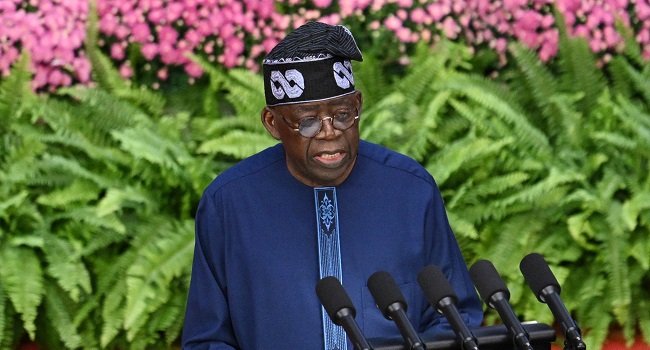
President Bola Tinubu has defended his administration’s proposal to secure external loans, emphasizing that Nigeria requires long-term capital investments in transformative infrastructure to achieve its target of building a $1 trillion economy by 2030.
The President explained that the proposed funds will be channeled directly into constructing key arterial roads, stabilizing national power supply, upgrading maritime ports, and funding projects that generate jobs, empower businesses, and secure opportunities for future generations.
His defense comes in response to inquiries from the Nigeria Labour Congress (NLC) regarding the executive request submitted to the National Assembly for approval to borrow $20.5 billion and €1.45 billion, despite recent surges in government revenue following petrol subsidy removal.


In an official statement titled From Reforms to Delivery: Our Infrastructure Investment and Growth Strategy, President Tinubu argued that public focus should center on project delivery and long-term economic value rather than total debt volume.
“The key question is not how much we borrow, but what we build, the value we create and the future we leave behind,” the President stated.
He highlighted landmark legacy projects earmarked for funding, including the Lagos-Calabar Coastal Highway, the Sokoto-Badagry Superhighway, the Trans-Sahara Superhighway, national grid transmission upgrades, and major commercial seaport modernizations in Lagos.
Tinubu noted that these infrastructure assets, combined with investments in education, healthcare, and technical skills training, will interlink regional markets, drop logistics overheads, boost manufacturing, and drive private capital inflows.
Specifically, the President estimated that the Lagos-Calabar Coastal Highway alone could lower regional freight costs by 15 to 20 percent and boost Nigeria’s Gross Domestic Product (GDP) by up to two percent through expanded commercial trade, industrial activity, and tourism.
He further projected that the coastal highway project will create roughly 100,000 direct jobs in heavy construction and civil engineering, alongside more than 150,000 indirect jobs across building material supply chains and logistics services.
“We are building more than highways. We are opening economic corridors, connecting markets, supporting industries and reshaping Nigeria’s economic geography,” he said.
Maintaining his stance on economic expansion, Tinubu reiterated that expanding the nation’s economic output to $1 trillion by 2030 is unattainable using legacy infrastructure designed for a smaller economy.
“We cannot build a $1 trillion economy with infrastructure designed for an economy a fraction of that size,” he added.
The President highlighted positive macroeconomic trends recorded since the implementation of key policy reforms in May 2023, including the discontinuation of fuel subsidies, foreign exchange rate unification, tax system modernization, and inflation management measures.
He cited statistical gains indicating that Nigeria’s economy expanded by 4.43 percent in the second quarter of 2026, while headline inflation decelerated to 14.63 percent in September from 20.98 percent recorded in the corresponding period of 2025.
According to figures released by the President, gross external reserves stood at $55.1 billion as of October 9, 2026, with net liquid reserves accounting for approximately $46 billion.
He added that the country’s tax-to-GDP ratio rose from seven percent to 12.5 percent, while net distributions from the Federation Account Allocation Committee (FAAC) surged by 44 percent, rising from ₦15.2 trillion in 2024 to ₦21.9 trillion in 2025.
Tinubu affirmed that these fiscal metrics have strengthened international investor confidence, enabling the country to secure favorable credit conditions on global capital markets.
He cited favorable sovereign ratings from global credit agencies, Nigeria’s re-entry into international Frontier Market indices, and successful Eurobond issuances as clear indicators of growing fiscal credibility.
“These are not political endorsements; they are independent assessments by global rating agencies, index providers, regulators and investors, recognising stronger external reserves, improved macroeconomic management and greater financial credibility,” Tinubu stated.
He emphasized that his administration is pursuing long-tenured financing structures designed to align repayment timelines with the operational lifespans of completed assets, thereby minimizing short-term debt service pressures.
Acknowledging fiscal discipline boundaries, the President noted that Nigeria’s public debt stood at 35.75 percent of GDP in Q2 2026, with debt servicing consuming roughly 65 percent of revenues in the first half of the year.
He assured that the Federal Executive Council’s fiscal strategy strictly rules out Central Bank deficit financing (Ways and Means) and prohibits unbacked pre-election expenditure commitments.







No Comments