


🎧
Listen to this article
President Bola Tinubu has presented the United States District Court for the District of Columbia with four distinct reasons why his unredacted files from the Federal Bureau of Investigation and the Drug Enforcement Agency should not be made public.
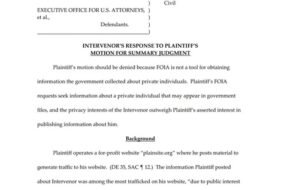
In legal filings published on Saturday through his defense team—comprising Christopher Carmichael, Victor Henderson, and Oluwole Afolabi—the President stressed that the U.S. Freedom of Information Act and Privacy Act bar the disclosure, asserting that no valid public interest exists in the matter.
Tinubu further maintained that there is no public interest component to weigh against privacy protections, arguing instead that the plaintiff is driven by hidden political motives in demanding documents bearing his name.
This legal response addresses a transparency lawsuit initiated by American activist Aaron Greenspan, who seeks the release of the records under the Freedom of Information Act.
Meanwhile, domestic opposition parties have criticized the move, contending that the Nigerian public has a fundamental right to understand the President’s historical background.
The scrutiny surrounding Tinubu’s U.S. legal history intensified ahead of the February 25, 2023, presidential election, following the emergence of documents concerning a 1993 U.S. civil forfeiture case.
At the time, a U.S. District Court in Illinois ordered the forfeiture of $460,000 held in an account under Tinubu’s name after U.S. authorities alleged the funds stemmed from narcotics trafficking or prohibited financial transactions.
Throughout the presidential election petitions, the All Progressives Congress insisted that the matter was purely a civil forfeiture proceeding rather than a criminal conviction.
Conversely, the Labour Party and former presidential candidate Peter Obi contended that the forfeiture constituted a disqualifying conviction under the Nigerian Constitution.
The Presidential Election Petition Court ruled in September 2023 that the petitioners failed to prove Tinubu was ever arrested, charged, tried, or convicted in a criminal case within the United States.
Interest from opposition figures and external parties in acquiring official U.S. documentation regarding the President has persisted ever since.
The President’s arguments
Greenspan previously argued that his request involves the “sitting President of Nigeria…” and “a nation of over 230 million people whose daily lives are directly affected by President Tinubu’s decisions.”
In opposing the FOIA request, Tinubu’s legal representatives urged the U.S. District Court to dismiss the action based on four core arguments:
1. FOIA and Privacy Act Block Disclosure: The President’s attorneys emphasized that the statutory privacy clauses under both the U.S. Freedom of Information Act and the Privacy Act strictly preclude disclosure, citing Exemption 7(C) which protects personal information contained in law enforcement records. They relied on a 1989 U.S. Supreme Court precedent to argue that FOIA exists to inform the public about governmental conduct rather than the affairs of private individuals.
2. No Public Interest in Disclosure: The legal team specifically rejected the argument that public interest in Tinubu’s fitness for office or background constitutes a recognized or balancing public interest under U.S. FOIA laws, maintaining that the requested records reveal little or nothing about an agency’s own conduct.
3. Political Motives Behind the Request: Tinubu’s lawyers targeted the political undertones of the lawsuit, pointing out that Greenspan’s submissions demonstrated a singular, overarching goal and focus on obtaining documents specifically bearing the President’s name for domestic political leverage in Nigeria.
4. Speculative Allegations Not Enough: The defense dismissed claims that the records could uncover a covert prosecution or a hidden non-prosecution agreement between U.S. authorities and Tinubu, labeling such assertions as entirely speculative, unsupported by evidence, and insufficient to justify a request for information about an individual.
Tinubu seeks continued withholding
Addressing claims that his privacy rights had lapsed because certain elements of the historical probe previously leaked into the public sphere, Tinubu’s counsel rejected the premise.
While Greenspan noted that the general scope of the investigation has been publicly known since 1993, the defense countered that the 1993 forfeiture records and associated affidavits never detailed the specifics or final disposition of any potential criminal inquiry involving the President.
The lawyers maintained that even if isolated fragments of information surfaced previously, individuals maintain a protected privacy interest in details that remain confidential.
Consequently, they requested the court to reject Greenspan’s motion for summary judgment and permit the FBI and DEA to uphold their redactions and withholding protocols.
The documents requested encompass the complete FBI file on Tinubu alongside FBI Form 302 interview transcripts spanning from 1992 to 1993.
In April 2025, U.S. District Judge Beryl Howell mandated that the FBI and DEA drop their initial “Glomar” responses—whereby the agencies declined to confirm or deny the existence of responsive records—and directed them to process the files under applicable exemptions.
Since then, the FBI has moved to protect segments of the files from release, citing exemptions protecting law enforcement data, personal privacy, investigative methodologies, and individual safety.
This ongoing FOIA litigation deals exclusively with access to U.S. government archives and does not represent a criminal trial or a judicial finding that Tinubu engaged in drug trafficking.







No Comments