

🎧
Listen to this article
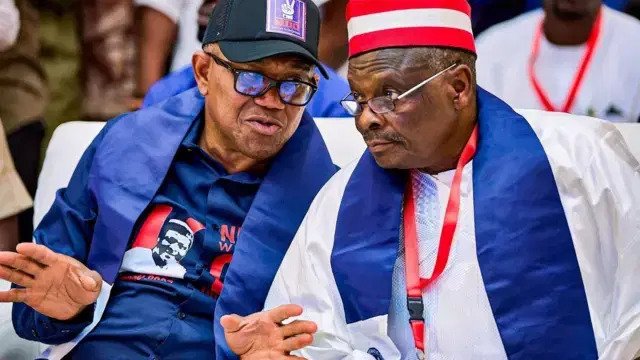
The vice-presidential candidate of the Nigeria Democratic Congress (NDC), Rabiu Kwankwaso, stated on Tuesday that a future administration led by Peter Obi would reintroduce fuel subsidies in a modified form.
Kwankwaso, a former governor of Kano State, revealed this during an appearance on Arise TV while addressing the current energy policies of President Bola Tinubu and analyzing political options ahead of the 2027 general election.
While both Obi and Kwankwaso have strongly criticized the incumbent administration’s management of petroleum pricing—agreeing that citizens require relief from soaring pump costs—their approaches to achieving price stability reveal noticeable differences.
Obi, the NDC presidential candidate and former Anambra State governor, has maintained a firm stance supporting the total phase-out of petrol subsidies.
Reflected in his 2023 campaign manifesto and subsequent public statements, Obi’s perspective remains that the subsidy regime should have been systematically unwound.
According to Obi, the government ought to have first eliminated systemic corruption within the energy sector and built a transparent pricing framework alongside downstream petroleum operators before ending the policy.
Addressing legal practitioners at the 66th Nigerian Bar Association Annual General Conference in Port Harcourt in August 2026, Obi reiterated his opposition to restoring the old pricing mechanism.
“I subscribe and maintain that you need to remove subsidy. Mismanagement of the proceeds shouldn’t be the reason for not removing it,” he said.
Obi stressed that revenue recovered from removing the subsidy should have been channeled directly into fundamental public sectors like healthcare, education, and agriculture, alongside building up the country’s sovereign wealth reserves.
He further asserted that while the Federal Government recouped trillions of naira following the subsidy’s removal, it failed to transparently redirect those funds toward productive economic programs that could cushion the financial strain on citizens.
Conversely, Kwankwaso offered a contrasting framework during his Arise News interview, indicating that an NDC government would indeed restore subsidy relief, albeit under an entirely different operational structure.
“We are bringing subsidy in our own way,” Kwankwaso said.
The former Kano governor faulted President Bola Tinubu’s sudden announcement ending the subsidy on May 29, 2023, contending that implementing the decision without adequate economic buffers triggered widespread financial instability.
He noted that although major contenders in the 2023 presidential race had pledged to phase out the subsidy, the execution lacked critical preparation.
Kwankwaso proposed that the state actively encourage and finance the expansion of domestic refining infrastructure—both private and public—to ensure petroleum products are processed locally and sold at lower prices.
“If individuals in this country can build refineries, I see no reason why government under certain circumstances will not build refineries,” he said.
He emphasized that the overarching objective of the party remains doing “whatever it takes to put the price of oil down.”
These diverging positions have sparked debate regarding how the NDC intends to align the economic visions of its presidential candidate and running mate.
While Obi insists Nigeria must never return to the previous subsidy structure, Kwankwaso continues to advocate for state interventions that amount to introducing subsidy “in our own way.”
Despite both leaders agreeing that the burden of high fuel costs on ordinary Nigerians must be mitigated, their core strategies diverge.
Obi prioritizes maintaining subsidy removal, curbing corruption, and redirecting public resources into essential infrastructure, whereas Kwankwaso emphasizes direct government backing for local refining and targeted price-reduction mechanisms, including a modified subsidy model.





No Comments