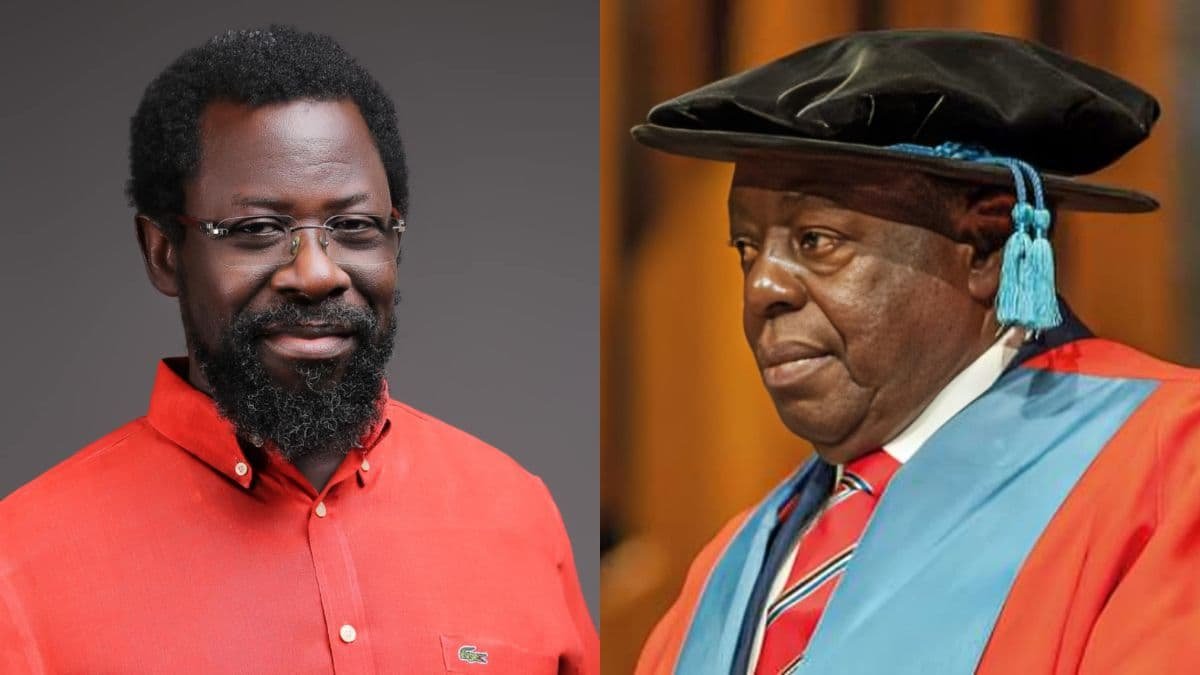
A book authored by activist lawyer Dele Farotimi has sparked a strong reaction from legal luminary Afe Babalola, the founder of Afe Babalola University (ABUAD) in Ado Ekiti.
The book, titled Nigeria and its Criminal Justice System, offers an unflinching critique of Nigeria’s justice system, with Farotimi accusing Babalola, a prominent figure in Nigeria’s legal circles, of using his influence to manipulate the Supreme Court in order to secure a fraudulent judgment for his clients.
In this candid and unrelenting account, Farotimi provides specific details, names, and references to events, making it one of the most scathing critiques of perceived corruption within Nigeria’s judiciary.
Babalola has strongly denied the allegations presented in the book.
One of the key examples cited by Farotimi is the case of Major Muritala Gbadamosi & Ors v. H.R.H Oba Tijani Akinloye & Ors, which he claims illustrates the pervasive corruption among lawyers and judges at various levels of the Nigerian court system. Farotimi argues that such misconduct reflects the broader systemic problems afflicting the country.
“The Nigerian justice system is in itself criminal, lending credence to how the criminality of the judiciary is completely reflective of the Nigerian state in its full ramifications and with full evidence of how this rot; having become systemic is insidious and reaches to the very top of the judicial system,” he stated.
Mr. Babalola filed a petition with the police in Ekiti State regarding his portrayal in Mr. Farotimi’s book, leading to a police raid on the author’s office in Lekki, Lagos State, on Tuesday.
In a move that has drawn widespread condemnation, the police escorted Mr. Farotimi to Ado Ekiti, where he was detained and later charged with criminal defamation.
On Tuesday, December 10, the police arraigned him on 16 counts before a chief magistrate’s court in Ado Ekiti, where he was remanded in prison until next Tuesday, when his bail application will be heard.
The content in Mr. Farotimi’s book, particularly in the Foreword and other sections highlighted by the police, triggered Mr. Babalola’s petition and led to the author’s arrest and prosecution.
The Foreword outlines 10 points that summarize alleged actions of Mr. Babalola and others, which contributed to the author’s broader assertion that Nigeria’s justice system is fundamentally corrupt.
Excerpts from the Foreword reads:
· That Aare Afe Babalola corrupted the Supreme Court to procure a fraudulent judgment in the service of his clients.
· That the law firm of S, B. Joseph & Co, procured a warrant to execute the said judgment by doctoring the original judgment of the Supreme Court.
· That Atilade O, Justice at the time and the Administrative Judge of the Lagos Judicial Division, unlawfully issued a warrant of execution based on the doctored judgment and without the enrolled order of the Supreme Court.
· That Atilade, J (Justice Atilade) quashed the fraudulently obtained warrant following an application of counsel in protest against same.
· That Aare Afe Babalola, Olu Daramola, Olu Faro and the law offices of Afe Babalola & Co, (Emmanuel Chambers) compromised the Supreme Court and the remaining semblance of integrity it might have had, when they went back to the Supreme Court and got that court to swim in the sewer of corruption and shameful self-abnegation.
· That Lawal Pedro SAN, at the material time the Solicitor-General of Lagos State, corrupted himself, abandoned the interests of the State, its citizens and any pretense to decency and became the undisclosed attorney to the Eletu family thus betraying the public trust.
· That Afe Babalola libelled me and the fact of the libel became known to me in his suit against Lawal Pedro SAN.
· That I sued Afe Babalola SAN for libel and that he leveraged his influence in the judiciary to deny me justice.
· That Oyekan-Abdullai, J was the instrument of injustice employed to deny me my day in court.
· That the Nigerian Justice System is criminal and complicit and can therefore not uphold the tenets of true justice nor the dispense thereof to which it is sworn.
Other claims by Farotimi
The police have identified additional excerpts from various pages of the book, which they consider defamatory towards Mr. Babalola.
These excerpts are included in counts 7, 8, 9, 10, and 11 of the defamation case the police have filed against Mr. Farotimi.
In these sections, Mr. Farotimi expanded on his accusation that Mr. Babalola was involved in corrupting Nigeria’s Supreme Court.
He claimed that Mr. Babalola, in collaboration with five Justices of the Supreme Court, undermined the court’s integrity and betrayed the interests of the citizens and the state they had sworn to protect.
In pages 10-11, Mr Farotimi wrote, “I have always been familiar with the fact of our perversion as a people and I have few illusions about equity and justice reigning in Nigeria but I had always assumed that there were lines that should never be crossed. I was however slapped awake by the brazenness of the judicial brigandage unleashed on hapless citizens, corporate, and individuals by the Nigerian Supreme Court, acting under the direction of Aare Afe Babalola. At least five Justices of the apex court have been identified as guilty of odious corruption and or gross incompetence”
In page 59, he wrote about the role of a judge of Lagos State High Court allegedly working along the direction of Mr Babalola, who he referred to as “the grandmaster of judicial corruption in Nigeria”.
The excerpts read, “But even as Atilade J played the contrition game, she was already part of the game plan corruption in Nigeria being stitched together by the grandmaster of judicial corruption in Nigeria, Afe Babalola. I have come to the conclusion that the required form of the application and her ruling were all part of the insidious plans of Afe Babalola, his band of crooked lawyers and coterie of crooked/incompetent justices of the Supreme Court.”
He also wrote on page 66, “But apparently, we had underestimated the extent of the putrefaction of the Supreme Court and the extent of Chief Afe Babalola’s corrupt reaches into the innards of the Supreme Court”
On pages 70 to 71, Mr. Farotimi claimed that the justices of the Supreme Court displayed extreme carelessness regarding the integrity of the court in handling Mr. Babalola’s case.
“But the court as though enthralled by whatever Afe the Circus Master had Promised the Justices, acted with utmost carelessness about the integrity of the court, the interest of the citizens and the State that they had been sworn to protect. The conspiracy was always a step ahead of us because some of the clients mistook key members of the confederacy of friends and helpers,” the excerpt read.
In page 80, the author stated, “But Afe knew that he could get the Supreme Court to do whatever he wanted and to rule however he asked. Pedro knew this too and he being the original Lagos boy, showed Afe a bit of Lagos magic. Afe Babalola and the Eletus might have killed the buffalo but had no way from feeding from the carcass. We have turned the corrupt triumph at the Supreme Court into a pyrrhic victory and it was at this point that Pedro craftily inserted himself into the plot.”
For More Information And News Update, Join Informant Online WhatsApp Channel With Link Below:
This is a civil case that is presumably a bailable offence but the fact that Farotimi was refused bail in this simple matter is a pointer that his remand in prison custody may have been influenced as he rightly alleged in his book about the ‘perverted Supreme Court case.’ Something needs to be done about personality influencing court cases in Nigeria, most especially at the Supreme Court level.





 https://whatsapp.com/channel/0029VaihFajBadmT29ufud2Z







One reply on “What Dele Farotimi Wrote About Afe Babalola”
This is a civil case that is presumably a bailable offence but the fact that Farotimi was refused bail in this simple matter is a pointer that his remand in prison custody may have been influenced as he rightly alleged in his book about the ‘perverted Supreme Court case.’ Something needs to be done about personality influencing court cases in Nigeria, most especially at the Supreme Court level.