

🎧
Listen to this article
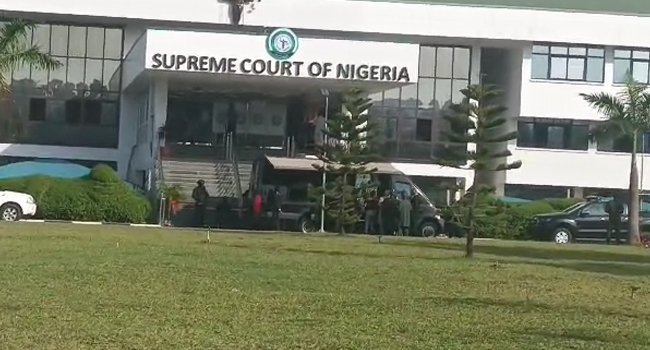
On Wednesday, the Supreme Court put a hold on its final decision regarding the legal battle between David Mark, the National Chairman of the African Democratic Congress (ADC), and Nafiu Bala, the party’s former deputy national chairman.
Justice Lawal Garba, presiding over a five-member panel, concluded the hearing after legal counsel for both sides presented their final arguments, noting that a date for the ruling would be shared with the parties in due course.
This case is seen as a landmark moment for Nigeria’s constitutional democracy. Having climbed through the various levels of the judiciary, the Supreme Court’s final word will be absolute, likely setting a clear boundary on how much the courts can interfere in the private politics of a party.
By “reserving judgment,” the justices have moved past the phase of active debate and into a period of private deliberation to interpret the law and relevant precedents.
The dispute touches on several vital sections of the 1999 Constitution:
-
Section 40: Protects the right to free association, which generally grants political parties the independence to manage their own internal business.
-
Section 6: Grants judicial power to the courts to resolve legal conflicts.
-
Sections 221–229: Provide the framework for party regulation and the oversight role of the Independent National Electoral Commission (INEC).
The court must now weigh the “internal affairs doctrine”—the idea established in Onuoha v Okafor that courts should stay out of party business—against more recent exceptions.
In cases like Amaechi v INEC and APC v Marafa, the judiciary intervened when parties ignored their own rulebooks.
Furthermore, the court must address the principle from Madukolu v Nkemdilim regarding whether the case was properly filed to begin with, especially since a lower court previously dismissed Mark’s appeal as incompetent.
The upcoming ruling is expected to decide two main things: whether Mark’s appeal is legally valid (competent) and whether the court even has the jurisdiction to settle this specific leadership fight.
This decision carries heavy consequences; currently, INEC does not recognize any faction of the ADC, leaving the party in a leadership vacuum that could jeopardize its participation in the 2027 general elections.
Ultimately, the Supreme Court’s verdict will do more than just resolve a power struggle within the ADC—it will serve as a definitive test of the balance between the supremacy of a political party and the overarching rule of law in Nigeria.









No Comments