

🎧
Listen to this article
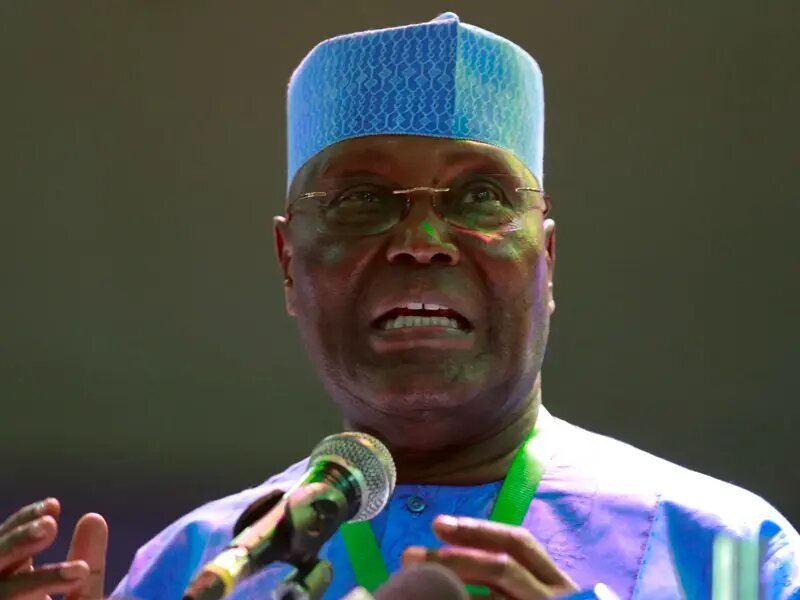
Nigeria’s former Vice President, Atiku Abubakar, has slammed President Bola Tinubu’s government for double standards regarding the management of petrol subsidies.
Atiku argued it is contradictory for the administration to boast about ending the subsidy regime while simultaneously offering tax breaks, financial concessions, and other monetary perks to players in the oil and gas sector.
The former Peoples Democratic Party (PDP) presidential candidate labeled the current government’s triumphant stance on subsidy removal as “one of the biggest economic frauds” presented to the masses.

He maintained that his alternative approach—a targeted relief mechanism—would shield struggling Nigerians without reverting to the corrupt and untransparent subsidy systems of previous years.
These remarks were contained in a Sunday press release signed by Phrank Shaibu, the Senior Special Assistant on Public Communication to Atiku.
Atiku observed that since he launched his Atiku Economic Recovery Plan, the Tinubu-led government has grown highly defensive.
This reaction, he noted, stems mostly from his suggestion to implement specific palliative measures for citizens battling the skyrocketing cost of living.
Pointing out the government’s contradictory policies, the former Vice President highlighted that ordinary families have been left to face the brutal reality of market forces after the petrol subsidy was scrapped.
Meanwhile, the administration is busy creating safety nets and risk-reduction incentives for wealthy oil investors.
“Tinubu stood at Eagle Square and declared that subsidy was gone. Petrol prices exploded, transportation costs soared, food prices followed, businesses buckled and household purchasing power collapsed.
“Nigerians were told there was no alternative and that enduring this pain was the necessary price of economic reform.
“But when major oil investors knock on Tinubu’s door, the sermon changes. Suddenly, government intervention is good economics; tax credits are necessary; fiscal concessions are strategic; and private investment must be ‘de-risked.’ Apparently, subsidy is only evil when poor Nigerians benefit from it,” he said.
To back his claims, Atiku referenced the administration’s Deep Offshore Oil and Gas Projects Incentives framework.
He explained that this policy grants eligible oil projects production tax credits starting between $3 and $4.50 per barrel. Under certain conditions, these supplementary credits can increase the total financial benefit to a staggering $11.50 per barrel.
The former Vice President strongly questioned the logic driving this one-sided government support.
“So, what exactly is Tinubu’s objection: government intervention itself, or government intervention for Nigerians?” he asked.
Furthermore, he cast doubt on the administration’s continuous use of the Petroleum Industry Act, PIA, as the legal backing for ending the subsidy. Atiku pointed out that the official audited financial records of the Nigerian National Petroleum Company Limited, NNPCL, contradict the government’s narrative.
Breaking down the figures, Atiku revealed that the NNPCL’s 2023 financial books logged roughly N4.84 trillion as energy-security costs and associated shortfalls. Strikingly, the company’s 2024 audited statements showed an even higher figure of about N7.13 trillion allocated to these same energy-security expenses.
He noted that the NNPCL justified these massive expenses by attributing them to the gap between the exchange rate applied to the regulated coastal price of petrol and the actual exchange rate at the time import bills were paid.
“In plain English, government was still absorbing a price differential after Tinubu had triumphantly announced that subsidy was gone,” he said.
In light of this, Atiku challenged the government to explain the glaring discrepancy between its public declaration of a subsidy-free era and its covert funding of petrol price gaps.
“If Nigerians were paying market prices because ‘subsidy is gone,’ why was the Federation still carrying trillions of naira in under-recovery and energy-security costs?
“If such intervention was lawful and economically necessary when Tinubu authorised it, on what intellectual basis is Mr Tinubu and his spokesmen now abusing Atiku for proposing an intervention that is targeted, capped, budgeted, independently audited and beneficial to Nigerians?” he asked.
Atiku also condemned the administration for hiding behind terms like “shortfall,” “under-recovery,” and “energy security” to mask government spending on petrol pricing.
“Whether government calls it subsidy, under-recovery, shortfall or energy security, public resources were being used to bridge a gap between economic cost and the price at which petrol was sold.
“You cannot abolish subsidy at the podium and resurrect it in the accounts under an alias,” Mr Atiku said.
The elder statesman accused Tinubu’s administration of running a “two-tier economic system.” In this setup, wealthy oil investors are handed financial incentives, while average citizens are abandoned to suffer the devastating blows of inflation and soaring costs.
“This is the fraud at the heart of Tinubunomics. Nigerian families are subjected to the harshest interpretation of market economics while major petroleum investors are offered incentives to improve the commercial viability of their investments.
“Tinubu cannot operate two economies in one country — brutally savage capitalism for poor Nigerian families and compassionate capitalism for big oil money operators. In fact, it is one rule for them and another rule for the rest of us,” he said.
According to Atiku, the administration’s readiness to dole out financial perks to foreign and local investors proves that government intervention can coexist perfectly well with market-driven economic policies.
“The government can protect a multibillion-dollar oil investment from risk, yet it says protecting the Nigerian worker from crushing hardship is bad economics.
“It can bend policy to make every barrel of crude more profitable, but tells a struggling mother that making the litre of petrol she needs to take her children to school more affordable is irresponsible,” he said.
Defending his proposed Atiku Economic Recovery Plan, he clarified that the blueprint is not aimed at bringing back the old, flawed subsidy system. Instead, it seeks to roll out a clear, targeted framework to help ease the burden of astronomical energy costs on the most vulnerable citizens.
“This is precisely why the Atiku Economic Recovery Plan rejects Tinubu’s false choice between the corrupt subsidy regime of yesterday and the cruel shock therapy of today.
“Atiku is not proposing a return to an unlimited, opaque and corruption-ridden subsidy racket. What he proposes is a targeted, capped, transparently budgeted and independently audited intervention with a clearly defined exit mechanism, accompanied by accelerated domestic refining, competition, mass transportation and measures to restore household purchasing power,” he said.
Atiku further wondered why state intervention is praised as brilliant economics when it favors billionaires, but heavily criticized as irresponsible when designed to alleviate the suffering of ordinary households.
“If Tinubu understands the logic of reducing the cost and risk borne by an investor in order to stimulate production, why does he suddenly become economically illiterate when the proposition is to temporarily reduce the crushing burden on Nigerian households?
“If government can legitimately de-risk investment, why is it economic heresy to de-risk survival?” he asked.
The former vice president charged the federal government with supplying “fiscal cushions” to wealthy oil barons, even as it forces struggling workers, petty traders, farmers, and households to swallow the bitter pills of subsidy removal and stringent economic reforms.
Despite his criticisms, Atiku made it clear that he is not against providing incentives to boost investments or attract foreign capital to the country.
“Let nobody deliberately misrepresent our position. Atiku supports investment, including foreign investment, and recognises the place of transparent and performance-based incentives in attracting capital.
“But what we reject is the intellectual dishonesty of pretending that government intervention becomes sound economics when corporations benefit and economic ignorance when Nigerian citizens benefit,” he said.
He also called for absolute transparency regarding the individuals and companies benefiting from these petroleum-related tax breaks, as well as a public breakdown of the true cost of these government concessions.
“Nigerians deserve to know the beneficiaries of major petroleum tax credits, remissions and incentives, the value of revenue surrendered, the investments delivered in return and whether Nigerian investors have equal and transparent access to comparable incentives.
“These concessions belong to the Nigerian people and must never become instruments of patronage dispensed behind closed doors,” he said.
Advancing his argument, Atiku stated that the true measure of any economic reform is how well it improves the lives of the populace, not how much pain it inflicts on them.
“Economic reform is not a competition over how much suffering a President can impose on his citizens.
“Removing subsidy without adequate buffers while simultaneously providing fiscal cushions to investors in the same petroleum industry is not courage. It is selective economics dressed up as reform,” he said.
He cautioned the Tinubu administration against celebrating the mere removal of subsidies as a victory, reiterating that success can only be claimed if the living standards of Nigerians genuinely improve.
“The test of economic reform is not how loudly a President announces that ‘subsidy is gone’; it is whether citizens are better off, businesses are productive, jobs are being created and household incomes can sustain basic living costs,” he said.
Atiku emphasized that his proposed economic recovery blueprint rests on a balanced approach: allowing markets to operate efficiently, ensuring investors get decent returns, safeguarding the nation’s treasury, and ultimately guaranteeing that the masses remain the primary beneficiaries of all state policies.
“A government cannot preach unrestrained market forces to the poor while practising interventionist economics for his rich foreign friends.
“It cannot demand sacrifice from Nigerian families while extending concessions to powerful corporate interests. It cannot provide cushions for corporations and punishment for citizens and then call the resulting misery reform.
“That is not economic reform. It is classic economic apartheid,” he said.
Concluding his statement, the ADC chieftain pledged to push forward with his targeted subsidy plan, regardless of the pushback from the ruling party.
He reassured the public that his proposed relief framework would feature strict spending caps, full transparency, and proper accountability.
Furthermore, it would be paired with policies to boost local oil refining, encourage market competition, and overhaul the public transit system.
“Even 100 million Tinubus cannot stop us from restoring targeted subsidy to suffering Nigerians,” Mr Atiku said.








No Comments