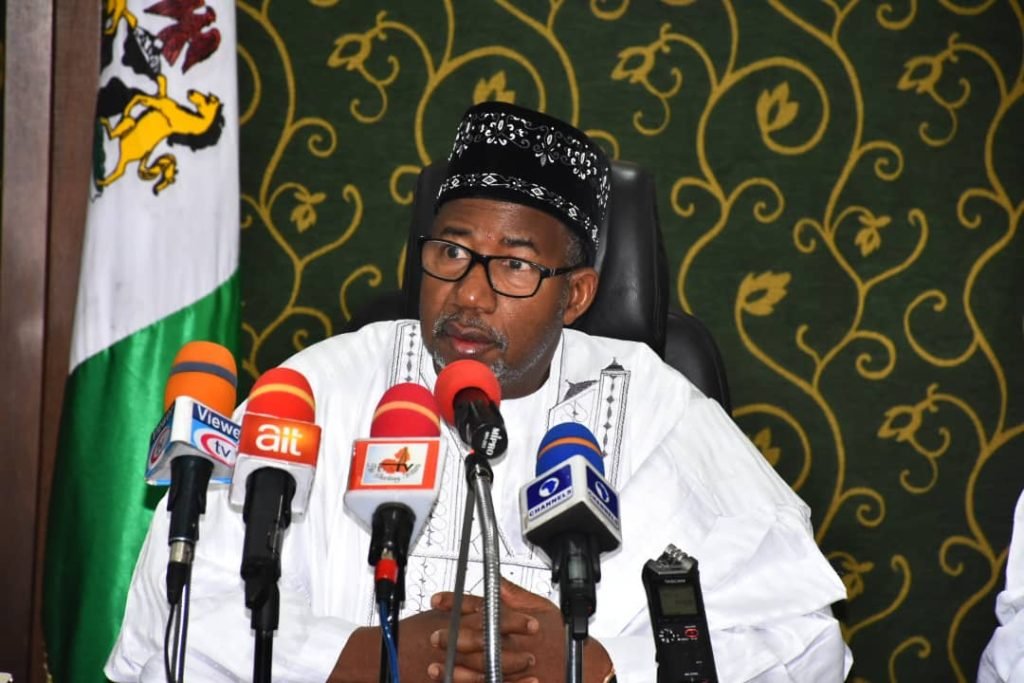
The Presidency has called on Bauchi State Governor, Bala Mohammed, to retract his threat to President Bola Tinubu regarding the tax reform bills.
A statement issued on Monday by President Tinubu’s Special Adviser on Media and Public Communications, Sunday Dare, and shared on his X handle, condemned Governor Mohammed’s remarks as “inflammatory.”
The governor had previously claimed that President Tinubu’s proposed tax reforms could “lead to anarchy” and warned that, if the reforms proceeded, the northern region would “show its true colours” in response.
Governor Mohammed made these comments while addressing the Christian community in Bauchi on Boxing Day.
He expressed concerns that the tax reforms could have detrimental economic consequences, alleging that the policies disproportionately favored one state in the federation.
He urged the federal government to reconsider its approach and adopt more inclusive policies.
However, the Presidency said, “I urge him to retract these confrontational remarks and redirect his focus toward productive dialogue with the FG regarding any concerns about the Tax Reform Act.”
The statement said Mohammed’s view does not reflect the view of the entire north.
“This unfortunate statement does not represent the collective voice of Northern Nigeria. The North, like other regions, seeks collaborative governance and constructive engagement with the Federal Government to address our nation’s challenges.
“Rather than issuing threats, his energy might be better directed toward implementing effective poverty alleviation programmes and ensuring transparent utilisation of these federal resources [N144bn received from FG]. The Tax Reform Act and increased federal allocations significantly benefit the States.”
“His statement ‘We will show President Tinubu our true colour’ is particularly concerning and does not reflect the constructive dialogue needed between the state and FG.
“It bears noting that Bauchi State has received N144bn (State and LGA) in federal allocations under the current administration – a significant increase from previous disbursements.
“Yet his state continues to grapple with serious developmental challenges and high poverty rates. As a state governor, he is called to exemplify statesmanship and work toward national cohesion,” Dare said.
The Presidency highlighted that the N144 billion federal allocation to Bauchi State represents one of the most substantial increases in federal disbursements, providing the state with significant fiscal resources.
This allocation includes a recent N2 billion special intervention fund, aimed at enhancing food security across all states. Furthermore, the removal of fuel subsidy compensation payments has notably increased state revenues, while special considerations for derivation funds are designed to protect the interests of northern states.
Minister Dare also emphasized that streamlining multiple taxation systems would ease the burden on small businesses in Bauchi.
He noted that efforts to improve revenue collection through digitalization, along with protections for informal sector workers—who are crucial to the state’s economy—and targeted provisions for agricultural businesses, reflect a concerted effort to support Bauchi’s farming communities.
The Presidency underscored that these reforms pave the way for further development by establishing frameworks to attract investments through tax incentives and strengthening the capacity of state revenue services.
These initiatives, it argued, demonstrate the Federal Government’s commitment to fostering state-level growth.
In October 2024, President Tinubu introduced a series of tax reform bills to the National Assembly aimed at overhauling Nigeria’s tax system.
The four bills—the Nigeria Tax Bill 2024, the Tax Administration Bill, the Nigeria Revenue Service Establishment Bill, and the Joint Revenue Board Establishment Bill—are designed to consolidate existing tax laws, streamline administration, and improve revenue generation.
Key provisions of the reforms include an increase in the Value Added Tax (VAT) rate from 7.5% to 10% by 2025, with further planned increments, and the introduction of a 5% excise duty on telecommunications services.
Dare pointed out that rather than opposing these efforts, Governor Mohammed could maximize their benefits by implementing transparent fiscal management systems, developing state-specific tax incentives to attract investors, and investing in agricultural value chains.
He argued that Nigeria’s path to prosperity requires a unified approach, stressing that regional divisions and political grandstanding should give way to the collective goal of building a stronger, more prosperous nation.
He called on public officials to rise above local and political sentiments and support the broader vision for national progress.
“The challenges we face—poverty to security, economic growth to social development—transcend state boundaries and political affiliations. Indeed, all political leaders must remember that their primary obligation is to improve the lives of their citizens, which is best achieved through constructive dialogue, efficient resource management, and unwavering commitment to national unity.
“The path forward lies not in confrontation but in collaboration, not in threats but in thoughtful engagement, and certainly not in divisive statements but in unified action toward our shared goals of development and progress.
“This is the true leadership Nigeria needs – one that builds bridges, not barriers, and prioritises the collective good over individual or regional interests. Finally, this Hausa might soothe the political nerves of the Governor—“Gyara kayanka baya zama sauke mu raba”
For More Information And News Update, Join Informant Online WhatsApp Channel With Link Below:





 https://whatsapp.com/channel/0029VaihFajBadmT29ufud2Z








No Comments