

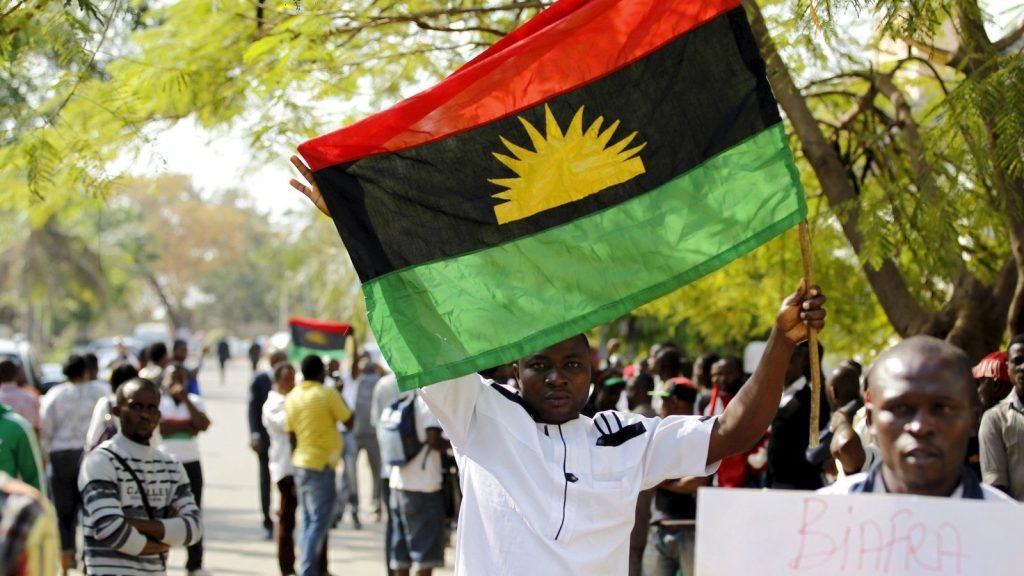
A three-judge panel, headed by Justice Hamma Barka, adjourned the case for judgment following the adoption of final arguments by both parties’ legal teams.
Representing the Federal Government, Oyilade Koleosho from the Federal Ministry of Justice was present, while IPOB was represented by a legal team led by Senior Advocate of Nigeria, Chukwuma-Machukwu Umeh. IPOB’s detained leader, Nnamdi Kanu, had previously applied to join the case as an interested party.
Read Also: Atiku Reacts As Court Order Restricts Rivers Allocation
IPOB seeks to overturn a ruling made by the late Chief Judge of the Federal High Court, Justice Abdul Abdu-Kafarati, who, on September 15, 2017, declared the group’s activities illegal in Nigeria.
This ruling followed an ex-parte motion filed by former Attorney General of the Federation, Abubakar Malami, on behalf of the Federal Government.
Justice Kafarati had not only banned IPOB’s activities, especially in the South-East and South-South regions but also instructed the AGF to publicize the proscription in the official gazette and two national newspapers.
On January 22, 2018, the high court dismissed a motion by IPOB challenging the legitimacy of the proscription order, with IPOB arguing that it had been obtained through misrepresentation.
IPOB alleged that the order implied labeling over 30 million Igbos as terrorists. Justice Abdu-Kafarati, however, ruled that IPOB posed a threat to national security and dismissed arguments that IPOB could not be sued since it was unregistered in Nigeria.
In its appeal, IPOB claims Justice Abdu-Kafarati erred by deeming that President Muhammadu Buhari’s approval, required under Section 2 (1) (C) of the Terrorism (Prevention) (Amendment) Act, 2013, was satisfied by an AGF memo dated September 15, 2017.
IPOB also contends that the lower court failed to consider affidavit evidence demonstrating that it is not a violent organization.


 https://whatsapp.com/channel/0029VaihFajBadmT29ufud2Z






No Comments