


🎧
Listen to this article
“Build, Don’t Just Consume Technology” — Fawole Tomi Challenges OAU Students at IBAC 3.0
Fawole Tomi, a Computer Science graduate and alumnus of Obafemi Awolowo University (OAU), returned to his alma mater as a technology entrepreneur and industry professional, joining a panel of experts to address students on the growing impact of technology on modern businesses.
Now serving as CEO of Axile Nigeria, his return to OAU represented a full-circle moment — from studying Computer Science within the institution to sharing practical insights on technology, entrepreneurship, business growth, and innovation with the next generation of students. Tomi shared his insights while participating as a distinguished panelist at the Ife Business Administration Conference (IBAC 3.0), organised by the National Association of Business Administration Students (NABAS), Obafemi Awolowo University (OAU).
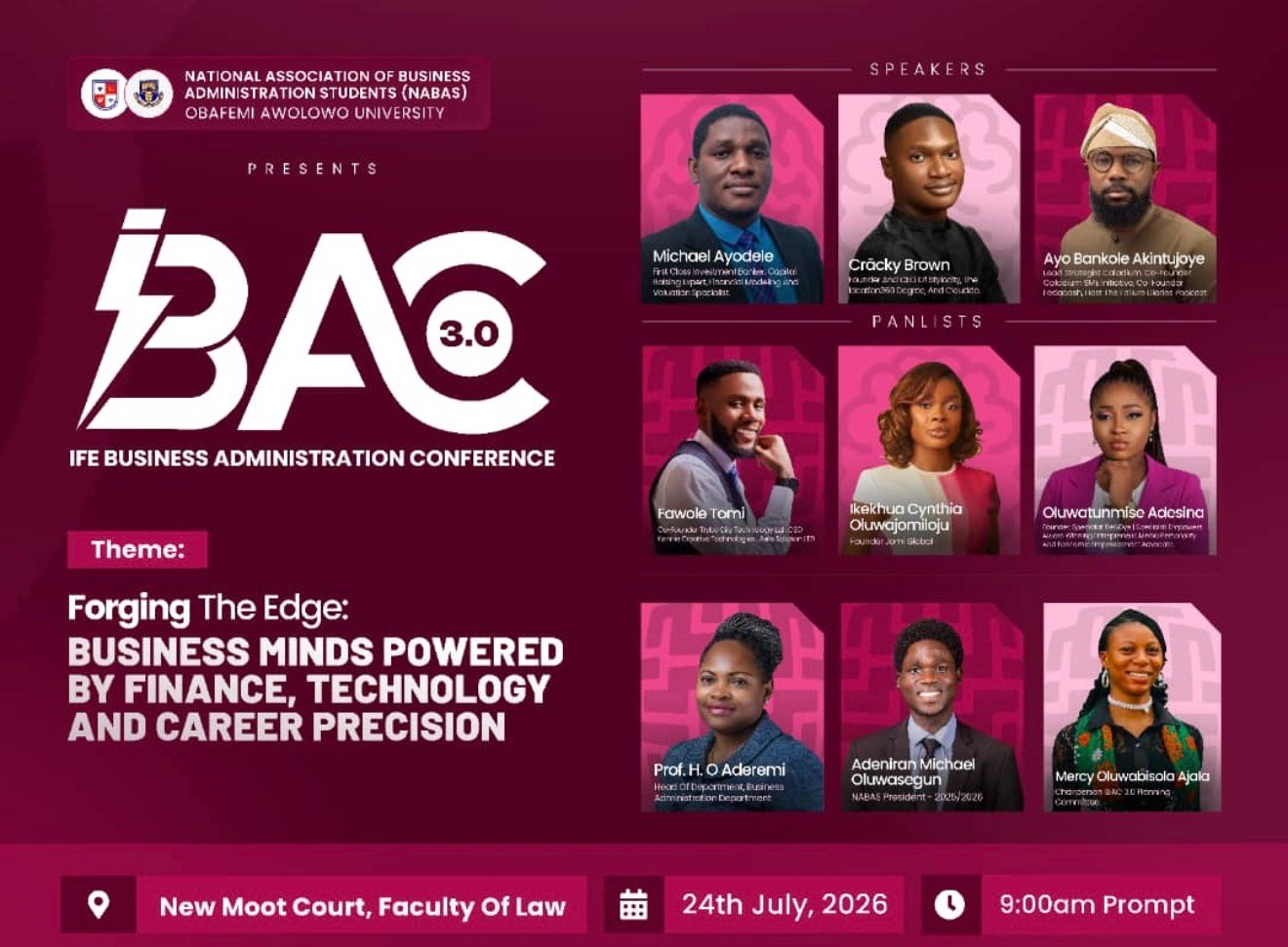
Held on 24 July 2026 at the New Moot Court, Faculty of Law, OAU, the conference brought together students, entrepreneurs, professionals and academics under the theme “Forging the Edge: Business Minds Powered by Finance, Technology and Career Precision.”



Speaking to participants, Tomi explored the growing relationship between technology and modern business, drawing from his experience building and contributing to technology-driven ventures.
Technology Is Changing the Way Businesses Are Built
During the discussion, Tomi highlighted how technology has transformed virtually every stage of building a modern business, from developing products and reaching customers to managing payments, marketing, communication, operations and decision-making.
He noted that emerging technologies, particularly artificial intelligence and automation, are giving entrepreneurs access to capabilities that would previously have required significantly larger teams and resources.

According to Tomi, this creates an important opportunity for young Africans to participate more actively in the digital economy.
“The opportunity for our generation is bigger than simply learning how to use technology. We have an opportunity to build with it — creating products and businesses capable of solving problems locally while competing globally.”
He encouraged students to develop practical digital skills alongside their academic education, stressing that technology becomes even more powerful when combined with an understanding of business, customers and the market.
Rather than waiting until graduation to begin gaining experience, he urged students to use their university years to experiment with ideas, develop projects, pursue internships and participate in entrepreneurial and technology communities.
Moving From Consumers to Builders
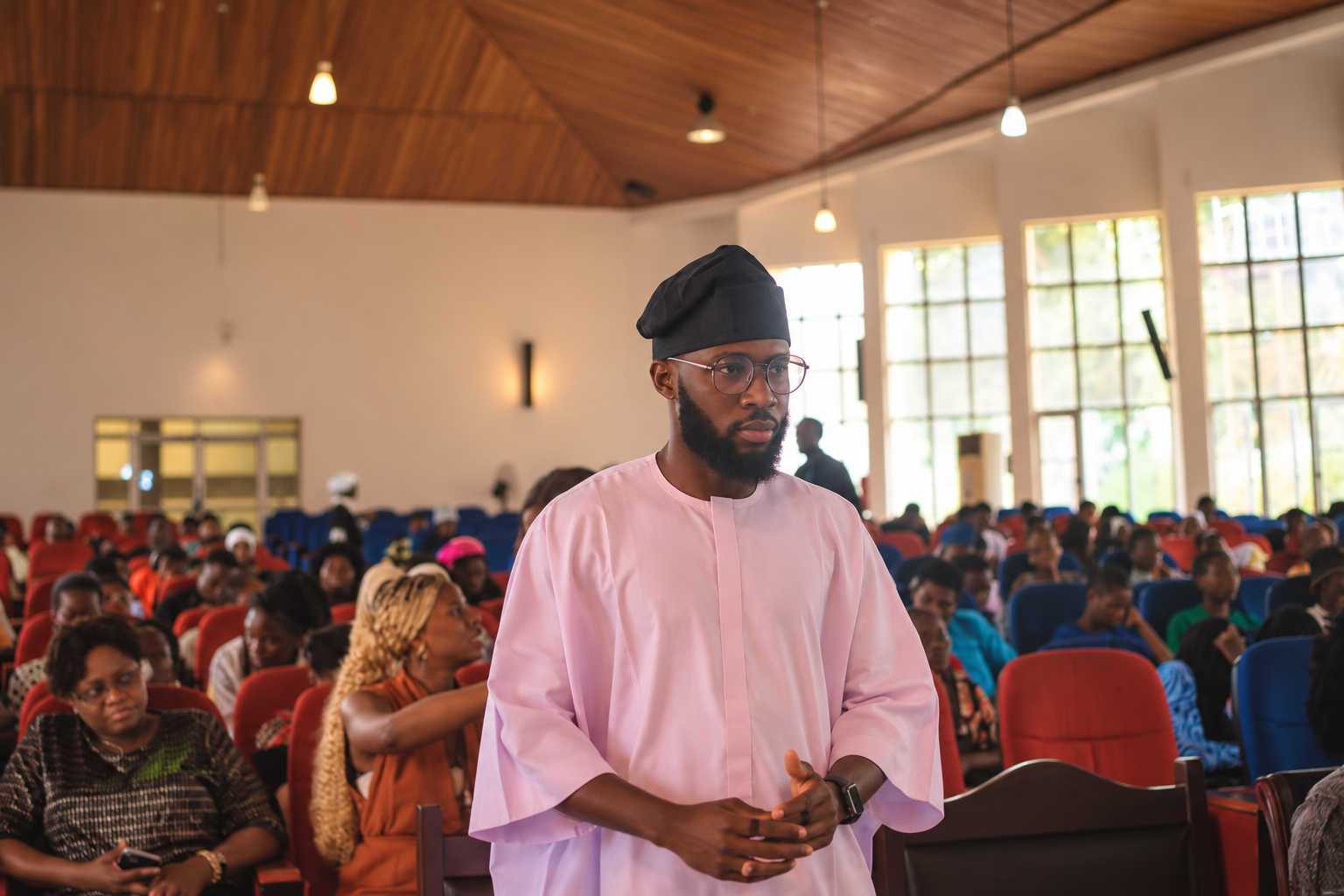
A major part of Tomi’s message centred on changing how young people think about technology.
While millions of young Africans use digital products every day, he believes more attention should be placed on developing the skills and confidence required to create those products and businesses.
He highlighted opportunities across fields including software development, artificial intelligence, cybersecurity, digital marketing and automation, while encouraging students to focus on solving real problems rather than following technology trends simply because they are popular.
For Tomi, the objective should not merely be acquiring certificates or learning individual tools. Young professionals should develop demonstrable skills and learn how to translate those skills into products, services and measurable value.
His own entrepreneurial experience spans technology, digital media and business.
Tomi is associated with Axile Nigeria, a technology venture developing digital solutions for the events industry, including infrastructure designed to help event organisers sell tickets and operate branded ticketing platforms.
His entrepreneurial activities have also included involvement with Trybe City Technology Limited, Kennie Creative Technologies and Inside OAU Media, exposing him to different aspects of software development, digital marketing, media, product development and entrepreneurship.
Putting Student Businesses to the Investment Test
Beyond participating in the main panel discussion, Tomi was also invited to evaluate business pitches presented by student entrepreneurs, giving young founders an opportunity to receive practical feedback on their ideas and business models.
During the pitch session, he challenged participants to look beyond simply identifying an important problem and presenting a compelling solution.
While acknowledging that successful businesses must solve genuine problems, Tomi emphasised that entrepreneurs seeking to build sustainable companies must also be able to demonstrate how those solutions translate into viable businesses.
His message centred on three important fundamentals: revenue, sustainability and profitability.

“A great solution does not automatically make a great business. You must be able to show who is willing to pay for what you are building, how the business generates revenue, how it sustains itself and how it can eventually become profitable.”
He encouraged the student founders to understand their target customers, pricing strategies, cost structures, revenue models and routes to profitability.
Tomi also stressed the importance of market validation, noting that entrepreneurs should continuously test whether customers genuinely want and are willing to pay for their products.
For early-stage businesses, such evidence could include customers, transactions, recurring users, partnerships, revenue or other measurable indications of demand.
“Investors are not investing only in the problem you have identified; they are investing in your ability to turn the solution into a sustainable business. Your numbers should eventually be able to tell that story.”
The session provided an opportunity for Tomi to interact directly with emerging founders, question assumptions behind their business models and offer recommendations on areas they could strengthen.
AI, Entrepreneurship and Africa’s Digital Future

Tomi also addressed the growing influence of artificial intelligence on business and the future of work.
He encouraged young people to approach AI as a tool that can enhance human capability, improve productivity and create entirely new categories of products and businesses.
With AI tools becoming increasingly accessible, he noted that smaller teams can now automate repetitive operations, analyse information, accelerate product development and compete in areas that previously required significantly greater resources.
However, Tomi cautioned that access to technology alone does not guarantee success.
Successful entrepreneurs still need creativity, execution, market understanding, technical competence and sustainable business models.
He believes Africa’s expanding technology ecosystem will require not only software developers but also entrepreneurs, product builders, cybersecurity professionals, artificial intelligence specialists and technology leaders capable of translating emerging technologies into practical solutions.
Recognition for Contribution to Entrepreneurship

At the conclusion of IBAC 3.0, Fawole Tomi received a Meritorious Award from the conference’s planning committee in recognition of his contribution as a distinguished panelist.
The recognition highlighted his practical insights on technology, entrepreneurship and innovation, alongside his contribution to conversations aimed at encouraging students to pursue excellence and develop commercially viable ideas.
For Tomi, participating in the conference represented an opportunity not only to discuss his entrepreneurial experiences but also to contribute to the development of young people interested in technology and business.
His involvement in both the panel discussion and student pitch session reflects a growing focus on technology entrepreneurship, knowledge sharing and supporting emerging founders.
Building From Africa for the World
Looking ahead, Tomi believes young Africans have an opportunity to participate in the global technology economy not simply as consumers, but as founders, engineers, innovators and business leaders.
He argues that the next generation of successful African technology businesses will emerge from entrepreneurs who combine innovation with a strong understanding of commercial fundamentals.
“The next generation of major technology companies can come from Africa. But that requires us to build — not just consume — and create solutions that deliver measurable value.”
His message to students at IBAC 3.0 was ultimately straightforward: learn continuously, build practically, understand the business behind the technology and develop solutions that people genuinely need and are willing to pay for.
For a generation entering a business landscape increasingly shaped by artificial intelligence and digital technology, Tomi believes those principles could determine who merely participates in the digital economy — and who ultimately helps shape its future.
Would you like me to make the tone more newsy or more personal?










No Comments